
There’s No Instant Success in Travel Blogging
Here’s something most beginning travel bloggers don’t want to hear but it’s the truth. If you start your blog today, you’ll probably hit the level where you are making real money that pays all your bills about 36 months from now.

It’s nearly impossible to speed this process up unless you’re already a travel blogger and you start a second or third site. You can do everything right on the setup, put up a new quality post every day, and promote like crazy through the four stages of a successful blog. It’ll still take about three years. It’s what Dan from the Tropical MBA podcast and David from Greenback Tax Services call the “1,000-day Principle” for new online businesses – not just travel blogs.
Three years, 1,000 days, or 36 months. Assume it’ll take that long to make serious money as a travel blogger, the kind you would make from a desk job working for someone else at a company. If you work for a company now, you might want to keep doing that while you build your blog on nights and weekends.
Travel bloggers are more likely to see it take that long than some other businesses too because of the Google Sandbox and the natural slowness of getting indexed. According to a study from Ahrefs, 94.3% of pages currently ranking on the first page of Google took more than a year to get there.
It also takes a while to build up an e-mail list, to build up a social following, and to build up a reputation for knowing what you’re talking about.
Many travel writing seminars and classes focus on the glamorous side of the business because that’s what brings in the students and the bucks. Heck, it’s even what most books about travel writing do. They lay it all out like a display of pastries at a French bakery, with lots of exclamation points in their come-on copy. Get paid to travel! Free trips! Luxury suites at beach resorts! Mai Tais on the beach! Fine dining just for writing a quick review!

Every day is an adventure, right?
I saw these ads in magazines 25 years ago, now I see them all over the internet now from the likes of International Living, Great Escape Publishing, Writing.com, and others. There are probably a dozen just on Udemy.
One of the main reasons I don’t have Adsense on this travel writing blog is because I know it’s this kind of come-on crap that would show up every day. There are big bucks out there in making things look easy that really aren’t.
You can find similar ads for seminars on how to break into modeling, how to break into acting, or how to make it as a songwriter. It’s all about the payoff, with very little about the tough odds you face to get there—or the vast majority of aspirants who never make it at all.
How Travel Bloggers Make Money
Most successful travel bloggers, like the ones we have reviewed here on Travel Writing 2.0, are earning an income from many different sources. I don’t think I’ve met any that are getting paid from less than 4, but more often it’s 8, 10, or 12.
Those income sources usually have one thing in common though: the blogger has proven influence. Either the blog gets lots of the right visitors, the person gets lots of media attention, the person is known as an expert, or the blog is seen as a leading authority in their niche. The blogger is seen as an expert in some area, one that can influence people in her tribe to buy what she is recommending.
Income involves selling of some kind, whether that’s network banner ads that show up automatically, affiliate links to products, or the blogger’s own tours/books/itineraries/seminars, etc. If there is income from working with brands or destinations, that is because the travel blog is either reaching a large number of people or it is clearly reaching the right people that are a good match for the organization.

None of this happens quickly. You’re not recognized as an expert the first month you launch your new blog unless you have books out on the subject or you are already quoted in the media over time. You have to build up a body of work that shows people you know what you are talking about.
If you just set off on your first trip around the world, you are not an expert on being a digital nomad or round-the-world traveler. You are starting a “follow along with my journey of discovery” blog, which is the opposite of expertise. You can make up for that with ample traffic, but the traffic won’t come until you’ve been at it for a year anyway. Or more.
In other words, all the blogging income sources depend on influence, traffic, or both. I haven’t mentioned social media, which does lead to income for a rare few, but that still involves having a really large following that’s real (not bought followers) or a very engaged following. Preferably both, which gets harder all the time on these platforms we don’t control.
Why Does It Take So Long to Make Money From Travel Blogging?
It doesn’t seem fair that if you do everything right, play by the rules, and write great content, that it still takes so long to start making real money. Why do we have to plug away for years before getting rewarded for our efforts?
Well maybe because starting a blog is so damned easy. It doesn’t even cost much. Unlike opening a restaurant or starting a software company, launching a blog is almost free. You can pay for a nice theme, get fast hosting, and get a pretty logo made and you’re still out less than $300 for the first year. The rest is sweat equity. You put in the effort now, with almost no overhead, and reap the rewards later.
Google knows this too. If anybody can put up a website and fill it with content (some of it generated by AI bots or by scraping others’ work), then Google wants to be very slow and careful about which sites deserve to be featured in search results. Prove yourself, generate original content, and earn backlinks and eventually the Big G lets you into the club. Until then, it’s very hard to rank.

Here’s how Jon Dystell of the Fat Stacks blog described it in a recent newsletter when a subscriber asked how long it would take to get to 250,000 words of content that ranks:
My goal is to average 300 visitors per post per month. That means I’d need 166 published articles plus several months for them to rank. The question really is “how fast could I publish 166 articles?”
If I could publish two per day, it would take 83 days. It would still take at least 6 to 9 additional months for enough of those articles to start getting enough traffic. Absolute best case scenario would be 9 months (this would be lucky). Realistic scenario: 18 to 24 months.
I agree with this and I think most who have been through the process would agree too. If you get anything onto page 1 of Google in your first year of blogging, then you’re great at picking keyword phrases with low competition and you’ve gotten noticed.
To have that happen enough times to add up to 10K, 20K, 50K visitors though? That can literally take years. I’ve launched six sites over the years and none of them has passed 10K visitors in the first year. People I know have done it and one even got onto Mediavine in the first year, but that’s extremely rare and almost impossible if this is your first blog. You’d have to find a really obscure niche that nobody has covered or be extremely good at targeting low-competition keywords.
Patience and Persistence Are Key
I don’t have any stats on how many travel bloggers quit after a year or two, but I’m guessing it’s at least half of them. The pandemic even pushed some that had been at it for years to quit when traffic took a nosedive for six months or more.
It’s easy to get frustrated and quit if you don’t love what you’re writing about and want this to succeed with a burning passion. If it’s just some side hustle that you think looks like an easy path to the good life, you probably won’t make it. Being a travel blogger is fun, exciting, and yes even glamorous at times, but you don’t get most of the perks until you put in years of work to deserve them.
So mark three years from the date you started on your calendar and put a monthly dollar figure on there as a goal. If you have a good chance of getting 50K monthly unique visitors by then, you’ll probably be earning enough to live on if you do it right and generate enough content. If you live in Mexico like I do, or another cheap country, you might get there sooner.
Then you really can post those “office with a view” shots and it’s genuine, not a “fake it ’til you make it” scam.
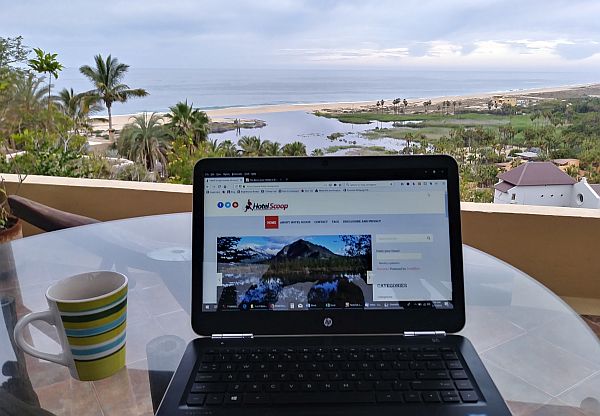
You have to have faith though, and keep plugging away for at least a year without knowing whether your content is really resonating or not. Then one week you’ll start to see an uptick. Then another. Then another. At some point your analytics report graph will start to look like a steep hiking trail. Go celebrate then and enjoy it. Until then, write about something you can write about for years without getting bored or dispirited.
If you want to get coaching along the way in detail, from someone who has done this six times now, get on the notification list for my Travel Writing Overdrive course and join the mastermind level. No promises of continually traveling the world for free and “being on permanent vacation” from me.
Meanwhile, there are other income streams you can pursue, like freelance writing, that I also go over in detail in the course. Other earnings can come faster, so get the mix right and you’ll see progress in your bank account at least while the blog is building up traffic.
Last, there is an easy button to leapfrog all this waiting time: buy an existing website instead. If you purchase a blog that’s already up and running, you can earn your money back in three years instead of waiting three years for something to happen.
About Author

Tim
Tim Leffel is the author of Travel Writing 2.0 as well as several other successful books. His work has been recognized by SATW, NATJA, and the Solas Awards. He has contributed to more than 50 publications as a freelancer and is the editor of four websites and blogs, including the "Best online travel magazine" and the popular Cheapest Destinations Blog, established in 2003. He served six years as Conference Director for TBEX and five years as co-chair of the NATJA Advisory board.
Thank you for this article, Tim. The thousand day rule seems true. I’m 2 years in with my blog Travel Writers Online over here in the UK and it’s just beginning to gain some momentum.
I also changed to a free Google BlogSpot midway to avoid all the admin work of the paid-for blog services. It is a great relief to simply write blog posts without all the maintenance and fees.
I don’t believe you can use any ad network or do direct deals if you’re on Blogspot though as you don’t own the domain. So no cost, but not much upside for revenue.
Thanks Tim. I think you’re right. The Google Blogger blogspot lets me put the frames in from Google AdSense but the ads do not appear on the live site, alas. On another note, your page here shows in my site’s Top 3 backlink referers.