
A Productive Writer is a Richer Writer
If you’re trying to make real money as a travel writer, travel blogger, or videographer, it’ll happen a lot faster if you just get faster at your main job.
I’ve been asking questions, hearing success stories, and helping my travel writing course students become more successful for 15 years now. So I’m constantly seeing what’s holding travel writers back, what’s keeping them from earning more money. The most common problem by far is publishing too little content. Factoring out all the variables, it’s safe to say that a productive writer is a richer writer.

I can say that with some personal confidence since I’ve been supporting myself full-time since 2006 as a publisher, author, blogger, and freelancer. I’ve always had enough income streams coming in that I could pay the bills, grow a business, and even put a kid through university with no debt. We own our house free and clear and have a nice chunk of money saved for retirement.
But I’ve seen that work well for others too, over and over. Most of the successful bloggers I know are very strategic about how they spend their time. They know what has leverage and what doesn’t, they are able to stick to task and get things done when they planned to get them done and deliver on any promises to external partners.
They don’t work on an article for two weeks unless it’s one of 10 in the draft folder. Or they’re a freelancer working on some complicated well-paid feature story that requires interviews, research, and follow-up.
They ship. They publish. They invoice.
Part of their success boils down to an attitude of getting things done above all else. They adapt, they pivot, they start new projects, but always with the attitude that they’re going to get some important things done today, this month, this year.
There are setbacks and delays sometimes, but no excuses. There’s no trail of unfinished projects behind them. As a freelance writer who was earning $100K+ annually said a decade ago at a conference I attended, “You can’t be successful until you have the courage to say, ‘Good enough” and hit ‘send.'”
“Good Enough” Consistently is Better Than Great Intermittently
I really like the theme of this article from Oliver Burke, writing as The Imperfectionist, called The 70% Rule. The main idea is that if your article or blog post or product you’re going to sell is 70% there, then let it rip. If you shoot for 100% you’ll probably never finish or it’ll take 10 times longer than it should have.
He makes a weight training analogy: over time that 70% bar will be rise to be 70% of a higher standard, just as when you’re weight training for months, the amount you can lift will get higher. You can’t bench press 100% of 200 pounds right away, but maybe you can lift 140, or 70%. Three months later if you keep at it, you’ll be lifting 70% of 240 instead.
Crucially, you’ll also be creating a body of evidence to prove to yourself that when you move forward at 70%, the sky stubbornly fails to fall in. People don’t heap scorn on you or punish you. Much of the time, they’re thrilled or grateful you stuck your head above the parapet…. You don’t need a perfect track record of accomplishments in order to get to count as an adequate human. And this knowledge frees you up to take further, bolder actions, because you’re no longer so fixated on preserving your track record.
He also applies the caveat that this doesn’t apply to everything anyone does. You want your surgeon to do the job 100% correctly, as well as the person designing a skyscraper or a bridge. Airline pilots don’t get to only go through 70% of their checklist.
But we’re talking about creative works here, not matters of life and death. Nobody dies if our article is only 70% great. I do think you should get as close to 100% as you can on the facts, but the rest of it, don’t stress about so much.
Especially if it’s your own blog. I’ve got blog articles that I’ve revised 8 or 10 times now since they came out. You can always improve upon your work later if you want. But if I’d never gotten the crappier first version out there to start with years ago, there never would have been a reason to update because there would have been nothing there for anyone to read.
Keep in mind I’m saying this as a guy who has won a whole wall’s worth of “best travel writing” award certificates and has edited at least 50 more winners as the guy behind Perceptive Travel. Maybe all of those could have been a bit better and maybe some that won a bronze would have garnered a gold if they were. But really, they were good enough to win a prize and get recognition, rather than toiling in draft form forever unfinished while the writer kept saying, “It’s still not good enough.”
Funny enough, last week I won a Gold award from the North American Travel Journalists Association’s “Best Travel Writing Awards.” This time it wasn’t for an article though. It was for a the Nomadico newsletter I’ve been putting out week after week on Thursday for nearly three years now, never missing an issue.
It wasn’t a flash of brilliance that won me that award. It was the courage to show up and get the work done week after week, no matter what was going on in my life otherwise.
Why Productive Freelance Writers Earn More Money

It should be dead obvious really, but if you’re a writer who is trading time for money as a freelance writer, the more articles you can crank out in a 160-hour month (or whatever it is), the more money you’re going to earn on an hourly basis. The longer the period of measurement, the truer this will be.
Sure, you’ll earn more at $2 a word than 10 cents a word, but I’ve sometimes made more from the latter because the $2-a-word job had an army of editors trying to second-guess my every word choice, with all of them wanting to put their personal stamp on the results.
When there are 40+ e-mails about a 200-word article, which happened to me during my one and only gig with Travel + Leisure, you can end up making less per job than the assignments where there were just slight edits and correspondence. But if you consistently get 12 assignments per month rather than 6 because you’re a productive freelance writer, then you’re going to earn far more money over time, especially in today’s market where opportunities are endless but pay rates are flat or worse.
Diversified income streams apply to freelancers too. Crank out the work for 12 different clients every month and you’re going to do much better than someone leaning on the one or two dependable gigs that only require half that many. (Until the editor gets laid off or the publication goes out of business…)
Why Productive Bloggers Earn More Money

For us self-employed online publishers it is not as cut-and-dry because bloggers eventually make a lot of passive income, the opposite of trading time for money. They can do absolutely nothing and go off the grid for a week or two and their earnings won’t falter. A month maybe if they’ve got good systems and helpers.
In general though, there’s a correlation over time between the number of articles going up on a yearly basis and how much that blog will earn. It’s far from consistent because there are so many variables like niche focus, search position, age of site, domain authority, e-mail newsletter activity, etc. Google’s changes since late 2023 have made all this even less predictable.
Still though, the blogs I see doing well over time are ones that a) have a clear focus and audience and 2) give that audience relevant new material on a consistent basis.
I can’t tell you whether you should be able to publish 12 posts a month or 4, but I can tell you that 1 a month is only going to get you to the minor leagues in earnings unless it’s a very old blog with a ton of archive posts that still get search traffic. In that case, you may only need to do updates regularly.
The main reason for this is you need more material in order to get more chances for something to click. Nobody can predict which articles will take off and which will not and often it’s the least expected ones that rise to the top. So the chances of one getting lots of hits increases drastically if you have 52 coming out in a year rather than 12.
The first edition of Travel Writing 2.0 came out in 2010 and I’ve been interviewing writers on this blog ever since. I’ve been going to (and speaking at) TBEX regularly since 2012 and I’ve been running my Travel Writing Overdrive course for nearly a decade. So I’ve had far more interaction with travel bloggers at all levels than almost anyone.
The most common problem I see is taking far too long to put up new content. Without new content coming out consistently, it’s very difficult to grow—or to maintain a healthy traffic level after growing. Instead of writing and hitting publish every week, the struggling bloggers are doing too much keyword research, putting in too much kitchen sink info, and being too precious about their prose.
Some Productivity Tips for Travel Bloggers and Writers

Very little of the advice I give my Travel Writing Overdrive students is original. Even if I think it’s my idea, it probably got lodged in my subconscious years ago after I read it in a book, saw an article, or listened to a podcast. Or I got it from some professional development session at a conference and have no idea when.
I just soak it all in and experiment a lot. I stick with the things that work and discard the ones that don’t.
What works for me might not work for you though, so I’m not big on super-specific plans like the Pomodoro Technique or “working in sprints.” Instead I’m big on general concepts like doing your most important work first, narrowing down the big priorities, having a publication schedule, and that 70% Rule we started with.
Much of just boils down to “Get s%$t done and keep moving forward.”
This has been one of my guiding questions from the beginning and I think about it every week:
Is what you’re doing today going to get you to where you want to be tomorrow?
Here are a few tips that will work for more people than not. Make them a habit and they become even easier, like starting the coffee brewing or exercising at a specific time each day.
Do Two or Three Key Things Each Day
If we jotted down everything we did in a day, the list could go past 100 items if you count social media posts, e-mail replies, and other quick tasks. If you look at what you really accomplished each day though, things that will move your business forward, there are often two or three tasks that really matter.
So each day, clearly define what those two or three things are and get them done. Most days, “creating content” should be in there in some form because if you’re a travel blogger or writer, it’s the core of your business. Others might be pitches, invoices, tech fixes, media appearances, or finalizing a trip, but if the content is not going out each week then something is out of balance.
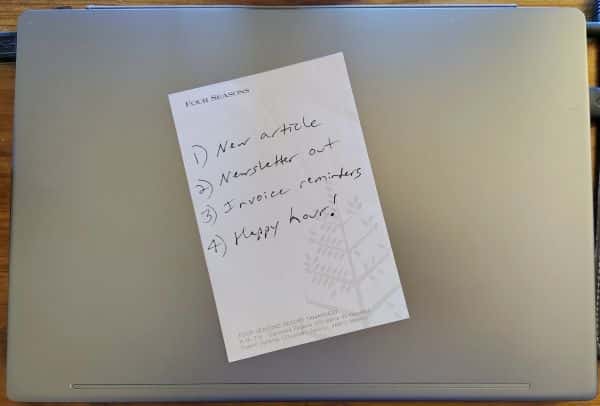
Don’t let the other 100+ nagging items on your to-do list get in the way. Apart from sending invoices, nailing down travel plans, and picking your kid up from school, most tasks can be put off repeatedly. I have a long list of things to do, but most of them go into the “eventually” bucket. Sometimes they sit there for months.
What are the key things? If you’re reading this, creating new content” is probably at the top, whether that’s freelance assignments, blog posts, edited videos, or edited photos. These are the output items that determine whether your next quarter’s earnings will be blah or great, then the quarter after that.
There are also things to get done that will keep you moving forward instead of backward: financial items to take care of, people to hire for outsourcing, a change in hosting or theme, new software to buy and set up.
Next might be projects that are for the near or far future: that book you’re working on, the lead magnet for your newsletter, the product you’re planning to sell, or those pitches you’ve been meaning to make for partnership deals.
Most of these are important “deep work” items that require a solid block of time and attention. They’re not two-minute tasks to cross off and be done while you’re watching TV. So do them when you’re at your most alert and productive.
For me that means the first few hours of the day. For others it might be after the kids are off to bed. Find your body clock’s most productive time and do your most important, most creative work then.
Don’t Start Your Day With E-mail
Unless there’s some urgent communication you’re waiting for, the worst thing you can do in the morning for your productivity (and mental health) is to reach for your phone and check e-mail. Unless you’re a night owl, you’re starting your work day by letting other people control your schedule and priorities.
For most people, you want to kick off your day with an accomplishment that is at the top of your key tasks list, not someone else’s. Most e-mails are selling you something, asking for something, or bothering you about something. They’re little dings about someone else’s agenda. Probably 49 out of 50 of them don’t even require an answer in the next 24 hours. Let them wait.
I don’t check e-mail or eat breakfast until I’ve accomplished something of substance in the morning. It’s a small thing, but compounded over days, weeks, and years, the impact is huge.
Limit Your Time on Social Media
During the money hours of the day, social media is a time suck that seldom has a real return on investment that you can bank on. It’s also a terrible way to start your day if you want to kick things off on a positive note. Whatever is getting a reaction gets to the top of your feed and often that’s because the post is negative or controversial.
Unless you are getting paid handsomely for posting on Instagram or TikTok, social media is probably giving you nothing but vanity stats, disappointment, and anxiety. Sure, you want to get the word out on what you’ve produced and you want to be visible where your audience is, but you can batch your posts using a scheduling tool or hire a VA to do it for you for an amount that’s far less than you’re earning per hour.
If you are spending more than an hour a day on social media, what could you get done in that time that would earn you money instead? If we sit down over a beer I can probably name 10 better uses of your time. If you are honest with yourself (and your phone is in another room), you can probably think of 20 tasks with more leverage.
Social media is the opposite of “high leverage” unless you’re fortunate enough to have your videos go viral and people actually click on the link. Or brands pay you more for posting on there than you could earn by other means. Otherwise, do it for fun in the off hours instead.
Write Sh!tty Drafts and Edit Like a Pro Later
It’s been said that there are two kinds of writers in this world. The ones willing to write sh!tty first drafts they will improve on later are the ones who typically get a lot more done. Every time you turn around they’ve got a new article out or they just published a book.
The others are those who painstakingly edit each sentence while they’re writing the first draft and they are are naturally going to be less productive. That process ends up being a whole lot slower and that compounds over months and years.
Writing that way might not be a bad idea if you’re a talented novelist cashing monthly royalty checks already each month. Or you write feature stories for The Atlantic that pay you high four figures. By nature though, that kind of writing style is better for long-form, highly paid narrative writers unless you really don’t need to earn money from this pursuit.
You even see this split in what version of WordPress bloggers use. Those who can write 2,000 words in an hour and then clean it up later are often still clinging to the classic editor in WordPress. (Hand raised.) Those who labor over every sentence while writing are just fine with blocks. They’re only doing a block at a time anyway. Then putting in a photo, then putting in a link, then an affiliate ad. Then moving on to the next block…
If you’re in the latter camp, it’s tougher, but at least try to bang out a draft now and then before you go into editing mode. It is possible to change your orientation if you’re aware of the problem and you can shoo away that perfectionist on your shoulder. Maybe try writing longhand even and see what happens.
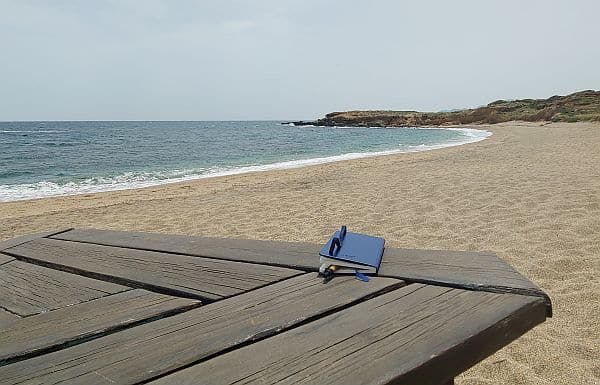
I do a lot of writing with no internet: on planes, trains, and buses, sometimes in a bar or coffee shop where I don’t even ask for the Wi-Fi code. It’s amazing how much you can crank out when you’re not trying to edit every phrase for the exact right word choice and you don’t overthink things as you go along. The clean-up, research, and link insertions can happen later (and don’t take as much mental energy).
Experienced fast writers use the “tk” function like sprinkles on a cupcake. Every time they need to look something up eventually or a paragraph needs some work, they do the editors’ trick of sticking in “tk” to mark something to come back to later. Then a simple search will find them all in the research and editing process since those letters almost never appear together in regular words.
It’s how I wrote the 3,000-word draft of this article in one sitting first.
This ability to write without constantly stopping is especially useful in the new age of blogging. Google is rewarding creativity over sameness and AI tools are handling the sameness just fine thanks to all the backward-looking material they’ve been trained on. If you can write raw, opinionated, emotional, or original articles that don’t look like anything else that’s out there, you’ve got a much better chance of ranking well in search than if you spend 8 hours doing keyword research to match what’s already been published.
If you write from the heart or write from experience on the first run-through, you’re far more likely to be producing something original. If you keep stopping to look at what other people have written or what’s already ranking in search, more and more sameness is going to creep into your first draft. Then it’s only going to get worse in the editing.
This is true in the freelance world as well, especially when it comes to pitching ideas. Editors want articles that fit their theme and ideal audience, but they’re constantly looking for what’s new and different. An original idea and then an article they’ve never seen before is the kind of work that gets you hired over and over instead of once and done.
Epilogue: I’m a Productive Practitioner

I once did a talk on blogger productivity at TBEX Europe and I could tell the people in the audience really needed to be there when I heard a huge gasp after I put up one particular slide.
That slide showed what I had published in the previous month across my various sites. It showed 15 articles plus a few book chapters and was clearly several times more output than most of them were getting done.
Some of the attendees came up to me after the talk was done asking for tips, saying things like, “I can never seem to post more than two articles a month.” This would be followed by excuses about traveling, about keeping up with social media, about slow Wi-Fi in the apartment they had rented for a week. These were people with just one blog and no freelance assignments on the side!
A lot of those travel bloggers aren’t bloggers anymore.
I’ve heard all the excuses and they’re mostly just that. Some people have true medical emergencies or family issues that get in the way, but most writers just need to get out of their own way and produce more.
I was traveling most of this past December, first on a small ship cruise, then sightseeing in two cities while alternating work time in an apartment. When I got back to where I live, it was December 26—after one holiday and before another.
But here’s what I published that month:
– 5 articles on the Cheapest Destinations Blog (3 new, 2 updates that were republished)
Those were 1,120 to 2,950 words.
– 1 narrative feature and 3 new blog posts on Perceptive Travel
Those were 1,407 to 2,297 words
– 1 hotel review and 3 blog posts on Luxury Latin America (2 new, 2 updates that were republished)
Those were 980 to 1,129 words
– 2 hotel reviews on Hotel Scoop
Those were 906 to 1,209 words
– 1 post on this Travel Writing 2.0 Blog – 2,321 words
– 1 freelance article for Global Traveler magazine – 800 words
I also sent out four issues of Nomadico and four other newsletters for various publications.
I also edited and posted a couple of videos on YouTube.
For what it’s worth, January’s output was about the same.
This is what’s possible if you have the courage to say, “Good enough” and hit the Publish button. Some of these may have only been 70% or 80% great, but they got finished and they’ve made me money.
P.S. – I haven’t mentioned AI in this whole article as a solution, but yes, that can help a little with your output. AI is especially good at cranking out very average content in a hurry. Articles that are 70% good are its specialty you might say, including 70% of the facts being correct. I do use it for outlines though sometimes.
I’m trying to encourage you to create unique content that will serve your niche audience well though, so you’re probably going to need to do most of that heavy lifting yourself if it’s going to be new and different.
About Author

Tim
Tim Leffel is the author of Travel Writing 2.0 as well as several other successful books. His work has been recognized by SATW, NATJA, and the Solas Awards. He has contributed to more than 50 publications as a freelancer and is the editor of four websites and blogs, including the "Best online travel magazine" and the popular Cheapest Destinations Blog, established in 2003. He served six years as Conference Director for TBEX and five years as co-chair of the NATJA Advisory board.